Choosing Between Spoken Directions and a Written Checklist
Spoken directions or a written checklist? Match the format to a task’s fixed steps and judgement, so another person can repeat it with fewer doubts.
The common mistake with spoken directions or a written checklist is treating them as interchangeable containers for the same instructions. A hurried explanation can leave the next person unsure of the order, while a rigid list can strip away the judgement that made the task work; the cost is repetition, avoidable uncertainty and a routine that drifts.
Passing on a repeatable task means deciding what must stay fixed and what should remain open to interpretation. Speech, writing and a combination of the two preserve different things. The best choice depends on what another person needs at the moment of action.
Separate fixed from flexible
Some tasks are mostly sequences: gather the materials, do one action, check the result, then continue. Others depend on recognising a condition, adjusting to a person or place, or noticing that something is not as it should be. Many familiar routines combine both.
Before choosing a format, identify the task’s stable parts and responsive parts. Stable parts include an essential order, a required item or a check that must not be skipped. Responsive parts include choices that depend on what someone sees, hears or is told.
A written checklist gives stable actions a visible shape. Spoken directions can explain why an action matters and how to respond when circumstances vary. These are tendencies, not strict boundaries: the question is what the next person can use at the moment of action.
Where speech helps
Speech suits tasks taught in company. A learner can watch an action, ask a question and hear an explanation at the point where it becomes relevant. Emphasis can distinguish an essential instruction from a suggestion, while conversation can address an unexpected condition.
This is useful when the task involves perception or local knowledge: recognising a sound, judging a texture or responding to a visitor’s particular request. The speaker can describe what to notice, demonstrate it and correct a misunderstanding before it becomes part of the routine.
But speech passes through attention. The learner may remember the broad idea but not the order, or miss a qualification buried in a longer explanation. A direction given once is especially vulnerable if the learner later has to work alone. Repeating it is not the same as leaving a durable record.
Spoken instruction suits a small group learning together, especially when questions and demonstration are part of the task. It is less suited to a recurring routine carried out by people who may not meet the original instructor. A useful handover can name the few details worth writing down rather than asking memory to preserve the whole conversation.
What lists preserve
A checklist makes selected actions visible and repeatable. It can sit beside the work, be consulted after an interruption and give different people a shared prompt. Its strength is not that it contains everything, but that it holds onto the items its author chose to record.
Lists work best when actions can be stated plainly and checked at a sensible point. “Confirm the parcel label matches the recipient’s name” is more useful than “check everything”, because it identifies both the action and the object of attention. Wording should distinguish a required action from an optional reminder.
A checklist can also make omissions more visible. If a task repeatedly pauses because someone needs to find a particular tool, the list can prompt the next person to gather it before starting. This does not mean every small motion belongs on the page: an overfilled list is hard to scan and can draw attention away from meaningful checks.
A list cannot answer every new question on its own. “If the label is unclear, ask the sender” may cover one likely exception, but no page can anticipate every circumstance. A list that presents judgement as a fixed rule can encourage someone to follow it when the situation calls for clarification.
Check the task first
Use these checks to decide what to record and what to teach aloud. Each observation should lead to a practical choice, with an alternative when the first format does not fit.
- Check whether the actions follow a stable order; if they do, write the sequence as a checklist, but if the order changes with circumstances, teach the decision points aloud.
- Check whether an omission is easy to spot before the task is complete; if it is, add a specific prompt at that point, but if it is not, include a separate review or handover rather than relying on a vague reminder.
- Check whether the person must recognise a sound, texture or other subtle cue; if so, demonstrate and discuss the cue, but if it can be described plainly, add a concise written prompt.
- Check whether the learner can ask questions while working; if they can, use spoken teaching to explain exceptions, but if they will work alone, record the limits and who to contact.
- Check whether people performing the task will share the same materials and setting; if they will, a local checklist may be enough, but if conditions differ, write the common steps and teach how to adapt them.
- Check whether the routine changes often; if it does, name a person or role to review the written prompt, but if it rarely changes, retain a clear way to report a discrepancy.
Combine teaching and prompts
For tasks that require both order and judgement, a short checklist can preserve the sequence while spoken instruction supplies the reasoning. The page then acts as a memory aid, not a substitute for learning. A demonstration can explain how to read the checklist and which signs call for a pause or a question.
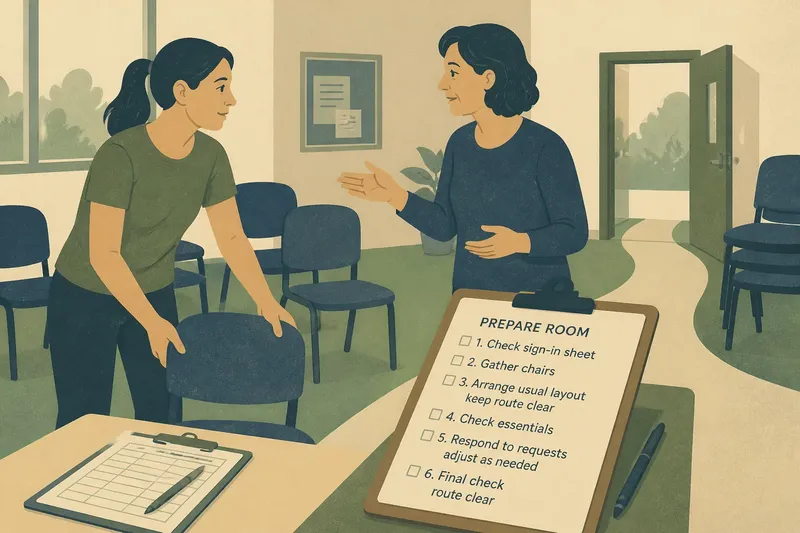
Say a community centre asks volunteers to prepare a room for a regular meeting. The starting inputs are a room with movable chairs, a sign-in sheet and a route to the door that must remain clear; the usual layout is familiar, but a request for quieter seating may change it. First, the volunteer checks the sheet and gathers the chairs. Next, they arrange the usual seating while keeping the route clear. Then the experienced organiser explains how to respond to a request for a quieter place, and the volunteer adjusts the layout without blocking the route. The resulting answer is a room with the essential items ready and a clear way through, while the seating remains adaptable. The tradeoff is deliberate: the checklist covers repeatable actions, while the explanation carries the judgement.
Keep the overlap deliberate. If the spoken explanation and written list disagree, the learner may not know which to follow. Review them together when the routine changes, and make clear whether the page records essential actions, suggestions or points for conversation. For safety or regulated procedures, use the responsible organisation’s approved material and seek a qualified professional where necessary.
It is not worth turning every routine into a laminated document or recording every explanation. If a task is occasional, low consequence and easily taught in person, a clear conversation may be enough. The useful record is the one someone can find and understand when the original speaker is absent.
Questions about formats?
When are spoken directions better?
Choose speech when demonstration, questions or interpretation are central to learning the task. It is particularly helpful when the learner must distinguish between conditions rather than repeat an identical sequence.
When does a checklist help most?
Use a checklist when actions recur in a stable order and an omission is easy to prevent with a visible prompt. It suits people who need to perform the routine independently or return to it after an interruption.
Can a checklist preserve judgement?
It can preserve a cue for judgement, such as what to inspect or when to ask for help, but it cannot always explain how to interpret a subtle sign. Pair the cue with spoken teaching when the right response depends on experience or context.
How should I decide between them?
Ask what the next person must remember, what they must notice and whether they can ask a question during the task. If order matters most, write the sequence; if interpretation matters most, teach it aloud; if both matter, use a concise checklist and explain its limits.
Keep the handover current
A useful handover preserves more than visible actions. It should make clear what counts as a completed task, which details can vary and what to do when usual conditions are absent. Those distinctions help prevent a prompt from being mistaken for a full explanation.
For spoken directions or a written checklist, choose the form that protects the part most likely to be lost. A stable sequence needs a reliable prompt; a responsive practice needs room for questions and explanation. When a task contains both, keep the record short and let instruction carry the judgement a page cannot settle.
Decide who will maintain the instruction. A checklist that nobody updates can preserve an obsolete routine, while spoken directions can drift as they pass from one person to another. Name a person or role responsible for noticing when the task changes, and make sure the method of teaching changes with it.