The Margin That Became Part of the Message
Marginal notes turn reading into a conversation across time, showing how marks beside a text can guide interpretation without replacing the original.
The common mistake with marginal notes is to treat them as private clutter or damage to a finished page. That can cost a reader useful context: a question, correction or connection made beside the text may shape how the next person understands it. Marginal notes turn a fixed text into a conversation between the reader, the page and people who arrive later.
The page has company
A printed or handwritten text appears to speak in one direction: words run from author to reader. A note in the margin changes that arrangement. It puts a second voice beside the first, making visible the fact that reading involves choices, doubts and associations.
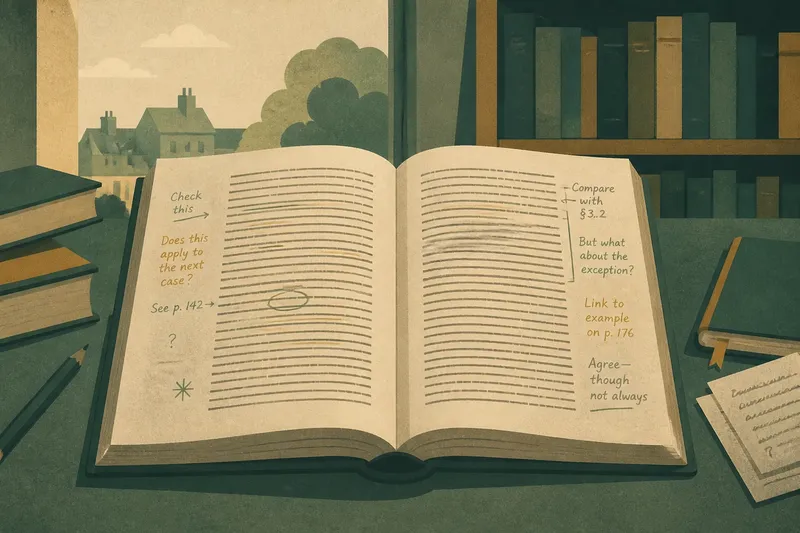
The note need not be eloquent. “Check this”, a pencilled question mark, or a reference to another page can record a moment of attention. Its value lies partly in what it preserves: not only what a reader thought, but where the thought arose.
Margins are especially revealing because they keep response close to its prompt. A comment beside a sentence can point to the exact claim, image or instruction that prompted it. Move the comment into a separate notebook and that connection may become harder to see.
From response to record
A private annotation becomes part of a shared record when another reader encounters it. The later reader may agree, object, follow its reference or simply notice that someone paused there before. The page now carries more than the original text: it carries traces of attention across time.
This does not mean every mark deserves equal authority. A note may be mistaken, playful or difficult to interpret. Its presence is evidence that a reader responded, not proof that the response is correct. Keeping that distinction clear lets annotations contribute without being mistaken for the author’s words.
Imagine a reader finding “Does this apply to the next case?” beside a paragraph in an old handbook. They add a brief note linking the question to a later section, and the next reader can follow that path while deciding independently whether the connection holds. The first question has become a small invitation, not a ruling.
Reading the layers
When a page contains several hands, handwriting, ink, pencil and placement can help distinguish one layer from another. A note squeezed between lines may respond to a particular phrase; a longer comment at the edge may address the passage as a whole. These clues are useful, but they do not always settle who wrote what or when.
Readers also bring their own habits to annotation. One person underlines claims; another writes objections; someone else marks unfamiliar terms and returns to them later. The pattern can show what kind of work the text invited, even when the individual notes are cryptic.
The margin’s shape matters, too. A cramped edge can force a comment into an abbreviation or symbol. A blank facing page offers room for a longer response, but loosens the immediate link between comment and passage. In either case, position helps the note make sense.
Preserving the distinction
Annotations can clarify a text, but they can also redirect it. A reader’s gloss may narrow an ambiguous phrase; a correction may quietly replace an unfamiliar reading with a more familiar one. Later readers should be able to tell when they are encountering the original wording and when they are encountering someone’s interpretation.
For a shared or fragile copy, consider using removable slips, a separate notebook or a digital transcription rather than writing directly on the page. If marks already exist, preserve their location and appearance when making a record; a transcription that copies the words but drops their placement loses part of their meaning. Follow the material’s care guidance when the page is valuable or delicate.
It is not worth trying to decode every anonymous tick or establish the exact identity of each hand if the evidence is absent. A cautious description—“pencil note beside the second paragraph”—can be more useful than a confident story built from a guess.
What do marginal notes do?
Are marginal notes part of the text?
They are part of the page’s reading history, but not necessarily part of the text as its author composed it. Keeping those categories separate allows the note to inform interpretation without being silently folded into the original wording.
Why write in a margin?
A margin keeps a response beside the passage that prompted it. A short question, cross-reference or correction can therefore remain legible as a reply to a particular place rather than becoming an unanchored thought.
How can readers distinguish a note from the original?
Look for differences in handwriting, medium, placement or visual style, and compare the mark with the surrounding text. If the distinction remains uncertain, describe what is visible rather than assigning an author or date.
Should readers annotate shared books?
That depends on the book’s ownership, condition and intended use. In a personal working copy, notes may help future readers; in a borrowed, archival or delicate copy, a separate record is often the more considerate choice.
A conversation without closure
Marginal notes rarely resolve a text once and for all. Their more modest contribution is to make reading visible: a line caught someone’s attention, a question remained open, or a connection seemed worth passing on. The page can hold those responses alongside its original words without pretending that every voice agrees.
That is why marginal notes remain useful even when a reader cannot identify their authors. They preserve the shape of an encounter and leave room for another one. The margin becomes part of the message not by replacing the text, but by showing how someone met it—and allowing the next reader to answer in turn.