How Household Cooking Knowledge Travelled Before Recipe Cards
How household cooking knowledge travelled before recipe cards: see how spoken cues, shared tasks and kitchen notes carried a dish between cooks.
The common mistake is to treat a recipe without written quantities as guesswork. Household cooking knowledge travelled before recipe cards through speech, shared work and remembered cues, but the balance varied by place, period and household. Calling those methods careless obscures what they demanded: attention to a dish as it changed.
Knowledge in the kitchen
There was no single route by which a household dish passed from one cook to another. In a kitchen where people cooked together, a learner might hear instructions, watch a familiar task and take over part of it. Elsewhere, a person might rely on remembered practice or a few written notes. These are ways knowledge can travel, not a claim that every household followed the same pattern.
Cooking knowledge was often more than a sequence of ingredients. “Add the onions before the flour” gives an order; “cook until soft” calls for a judgement about what to see or feel. The second instruction becomes more useful when a learner can compare the dish with a cook’s example.
Learning by doing
A demonstration can make a quality easier to recognise. A learner might see how finely an onion is chopped, watch a cook fold rather than beat a mixture, or handle dough to notice when it resists less. The point is not that touch or sight replaces words, but that action can give an otherwise vague instruction a shared reference.
Taking part matters, too. Stirring a pan, shaping pastry or checking a mixture lets a learner connect a spoken cue with a change in texture, colour or sound. Once the learner has done the task, a phrase such as “stop when the edges colour” may mean more than it did as a bare instruction.
Household measures
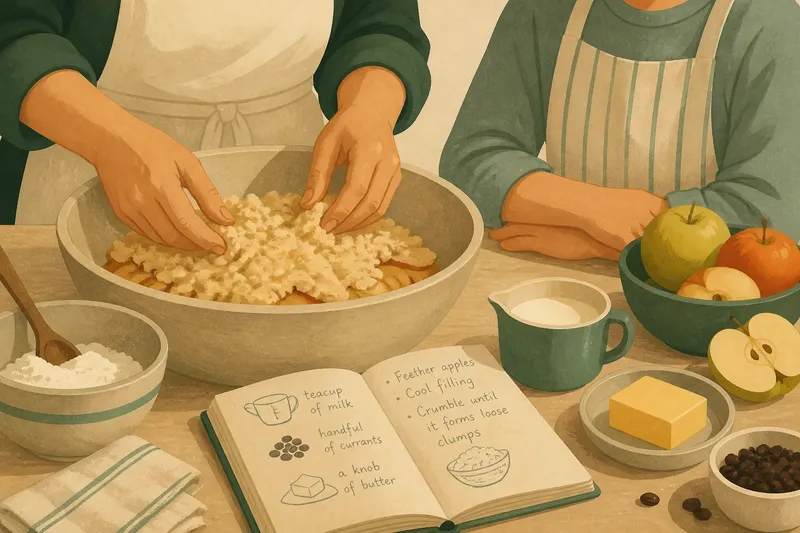
Expressions such as “a teacup of milk”, “a handful of currants” or “a knob of butter” tied an amount to an object or gesture familiar to the cook. They were not exact units in the way a written weight is, and a cup or handful could differ from one kitchen to another. Their usefulness depended partly on shared context.
A measure could also point to a decision rather than a fixed amount. “Add flour until the dough is workable” leaves the quantity open, but names a result to look for. Without knowing the intended texture, the instruction can be difficult to carry into another kitchen.
Why versions differ
Household methods could change as cooks adapted to available ingredients, equipment and taste. Two relatives might remember different versions because they learned from different people or cooked the dish for different occasions. Variation alone does not establish which version came first or whether one person has forgotten correctly.
Say you are making a familiar fruit crumble with unusually juicy apples. You begin with the amount of flour you remember, then add a little more as the topping turns pasty; you stop when it forms loose clumps. A younger relative watching can see the adjustment and its visible result, while still understanding that the amount may change with the fruit. This invented situation illustrates a possible teaching moment, not a historical claim about how a particular family cooked.
What memory misses
A person may remember a dish’s ingredients and broad order while overlooking a detail that affects the result, such as cooling a filling before enclosing it in pastry. Someone who has not watched the cook may know the phrase “until done” but not the colour, texture or smell that made it meaningful.
Knowledge can also remain concentrated in the person who does most of the cooking. Other household members may recognise a dish without knowing how to make it. That gap is one reason a remembered method can become harder to pass on when people no longer cook together.
Notes that travel
Writing becomes useful when a dish needs to make sense to someone who does not share its original cues. A note can identify the cup meant by “a teacup”, record the order of work, or describe a visible sign such as edges beginning to colour. It need not turn every movement into a formal recipe.
Not every detail merits transcription. Reconstructing a whole method in polished prose is not worth the effort if the dish is made regularly by people who already know it. A short note about the easily missed stage may be more useful than a complete account of familiar actions.
Questions about cooking knowledge?
Did every household use written recipes?
No single account fits every household or period. Some people kept written instructions, while others could learn a dish through practice, conversation or a mixture of methods.
How can a vague instruction become clearer?
Connect it to an observable cue: for example, describe the texture meant by “workable” or the colour meant by “ready”. If possible, show the stage while explaining it, so the learner can compare words with the dish.
Why might relatives remember different methods?
They may have learned from different cooks, at different times, or with different preferences. Their accounts can reflect distinct versions rather than a single fixed formula.
What should a useful kitchen note include?
Record the details a new cook cannot readily infer, such as an unfamiliar tool, an easily missed order or a cue for stopping. If an informal measure is used, name the object it refers to; the note then gives a reader a clearer starting point.
Passing on a dish
Household cooking knowledge travelled through a mix of practice, speech and writing, with no one method serving every cook. A note can carry quantities and sequence, while a demonstration can make texture and timing easier to recognise. For household cooking knowledge to travel beyond its original kitchen, recording one or two otherwise hidden cues may matter more than making every instruction exhaustive.